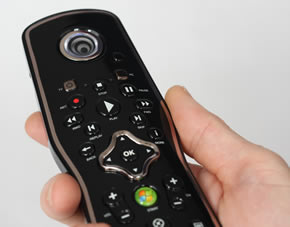
Are you a recent convert to home-automation and speech control? An existing Amulet owner interested in adding a second unit? Or just someone that likes tinkering with technology?
If so, you’ll be interested in our latest Amulet special offer. We have a small number of Amulet Voice Remotes remaining which we are selling over the next 12 days. This is your last chance to buy an Amulet!
If you thought Amulet was only for Windows Media Center users, think again. There is a thriving third-party software community built around voice recognition products like VoxCommando and others, which make it easy to add voice recognition to your automated home. Amulet is the perfect addition to any such household.
So don’t delay, buy your Amulet today. Better still, buy two! The offer ends on 18 October 2015, after which Amulet will no longer be available for purchase. (All orders ship within one working day and delivery usually takes 5-6 days within the USA.)
It’s been an exciting few years, and we’ve loved hearing from Amulet users all over the world. Thanks to everyone who has supported us in the past; now it’s time to do something else.
Posted in General | Comments Off on Amulet Stock Clearance
If you’re a My Movies user, you probably noticed the release of My Movies 5 recently. This is a major upgrade to My Movies 4, with many new features, and well worth installing if you’re a regular user.
Inevitably, some of these changes conflicted with Amulet’s My Movies plug-in, preventing voice control from working correctly with version 5. We’ve now corrected this, and have released an updated version of Amulet’s Media Centre software that is fully compatible with My Movies 5.
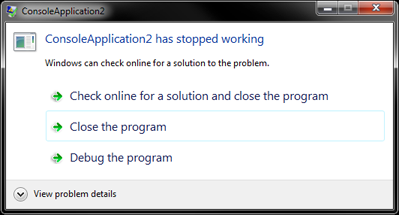
We took the opportunity to introduce another useful feature also. We’ve noticed that sometimes, third-party plug-ins can cause Media Center to crash for reasons beyond our control, in a way that produces a desktop error dialog similar to this one:
This is awkward to dismiss, since Windows won’t let you select any of the options using just the remote control — you need to connect a mouse or keyboard, or simply power-cycle your HTPC.
We’ve now introduced a new setting in Amulet Settings / Diagnostics which allows you to disable this desktop requester; instead, any programs crashing will silently crash back to the desktop, where you can simply restart Media Centre by pressing the green button. Details of the crash are still available in the system event log as usual.
(If you’re wondering what this setting actually does, it simply sets the registry setting \Software\Microsoft\Windows\Windows Error Reporting\DontShowUI to the value 1, under both Local Machine and Current User.)
As usual, we’re interested in your feedback on this release. Please contribute to the discussion in our user forums.
Now shipping to UK & Europe
If you haven’t visited for a while, you may not know that we’re now shipping Amulet Voice Remotes to the UK and Europe from our European base in Dublin. Shipping takes 2-3 business days from the time you place your order. While we still take payment in US dollars, this works out at about £40 for UK customers and €50 for European customers, with an additional £9 (€10) for shipping. Visit our online shop to place an order.
Posted in General | Comments Off on Amulet Software Release 4.1
Steve Collins, our hardware guru, has been experimenting recently with the new wave of smart watches to see how well they work as speech input devices. He’s put together a neat demo showing voice input from a SmartQ Z1 Android watch being sent over wifi to his XBMC media center, where Amulet’s voice recognition software converts the voice commands to actions.
Check out the video here:
You can read more about the technology involved in this thread on the XBMC forum. Let us know if this is an area that interests you.
Posted in General | Comments Off on XBMC Voice Control … from your watch!
James Richards at VoxCommando has released a slick new video showing off some of VoxCommando’s latest features.
You already knew VoxCommando worked well for controlling your music and video experience with XBMC, MediaMonkey, iTunes, and other software. Using its extensibility features, however, James has hooked it up to a bunch of his household appliances, so that he can control the TV settings (brightness, movie mode, on/off, etc), cooling fan, whole-house audio, and more.
The video also does a great job of demonstrating how well voice works as a way to have a two-way conversation with your home automation system, by having it remind you of things verbally, asking it questions (and receiving coherent answers), and a lot more. Read the rest of this entry »
Posted in General | Comments Off on Amulet and VoxCommando controlling your whole house
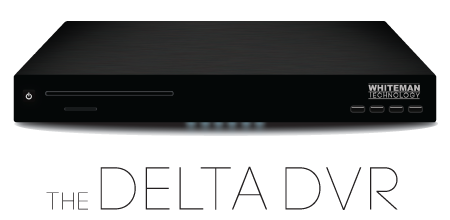
Our friends at Whiteman Technology are launching the Delta DVR at DEMO Spring 2012 in Silicon Valley tomorrow. It’s one of the first commercial DVRs based on Windows 7 Embedded running Media Center, and it includes the Amulet Voice Remote as standard.
It’s a very nicely designed piece of equipment, and has some impressive capabilities: Six HD tuners for recording TV, built-in 802.11N for wireless connectivity to all your other media sources within the house, integrated Blu-ray playback, and even a UI interface for downloading games from the app store. Not to mention, of course, full voice control.
If you’re in Santa Clara tomorrow afternoon, 19th April, why not call in to DEMO 2012 at the Hyatt Regency where Ryan will be demonstrating the Delta DVR on the main Demo stage at 3:45 pm. You can also visit Whiteman Technologies throughout the day at pavillion booth #D15.
Amulet users often ask us for additional voice commands to check the weather, perform unit conversion, read news headlines, and so on.
While we hope to incorporate some of these in a future software release, you can do a surprising amount right now using Amulet’s custom command capability, especially when you combine it with some VBScript.
To demonstrate, I’ve written a simple Visual Basic script to fetch the current weather forecast for your city from Yahoo Weather, decode the XML data returned, and speak the result using Amulet’s voice. Below, I walk you through it.
Note: This discussion is quite technical. If you’re comfortable editing text files with Notepad, you should be able to follow along fine, and adjust the script to suit your own purposes. Read the rest of this entry »
Posted in General | Comments Off on What is the Weather Today? Amulet’s Custom Commands
From time to time, we get enquiries asking whether the Amulet Voice Remote will work on an Apple Macintosh.
We designed the Amulet for use with a PC — primarily for Windows Media Center — and nobody in the company uses a Mac, so this wasn’t a use we had forseen. Since the Amulet dongle appears as a standard USB audio input device, however, I thought there was a good chance the Mac might recognize it.
(If you missed Part 1, which introduced Amulet Voice Kinect, read it here.)
So after deciding to see if HaarCascades would work at all with the depth-stream from Kinect, I figured I needed to give the first test the best chance of success. There was no point making a half-hearted effort, have it fail and then having to have another go because I wouldn’t have known if the failure was down to some fundamental problem with using the depth-stream with HaarCascades or just because I had poor HaarClassifiers. To give the test the best chance of success I would need several thousand depth images containing the object that I needed the classifier to recognise and several thousand negative images not containing the object. I settled on 2000 of each.
You may have previously seen in videos, early versions of the Amulet software being used with Kinect. Now the music functionality is finished and we’re ready to give it away. If it proves popular then we’ll release a paid version that will include all the other functionality currently in our Amulet Voice Remote product and more…
This video shows how it works:
I thought I’d make a posting to the Amulet blog to explain a bit of the background behind how and why “Amulet Voice Kinect” works the way it does. Read the rest of this entry »
If you’ve been following the Amulet beta software releases, you probably already know that Amulet V3.0 includes full voice support for the popular My Movies 4 plug-in for Media Center.
For everyone else, here’s a preview video showing how well the voice integration works:
If you’re not familiar with My Movies, it’s one of the nicest, most cleanly integrated Media Center plug-ins out there. It presents a very professional and user-friendly front-end to all your TV & Movie media files, automatically provides movie backdrops, descriptions, actor lists, etc. and even lets you store your own DVD titles directly on your Media Center; highly recommended.
Here’s something the video doesn’t show, which you might find interesting: while the SHOW MOVIE command shows details for any movie in your collection, you can bypass this and start the movie immediately, from anywhere in Media Center, by just saying PLAY MOVIEname. I find this very convenient when calling up Toy Story or Winnie the Pooh for the umpteenth time at the request of my three-year-old!
We’d love to hear feedback from those of you already trying out the beta software with My Movies. If you already have an Amulet Voice Remote and want to give it a try, head over to the beta forums and download the latest version.
Posted in General | Comments Off on Amulet adds voice control to My Movies 4.0


 Are you a recent convert to home-automation and speech control? An existing Amulet owner interested in adding a second unit? Or just someone that likes tinkering with technology?